

Civil society engagement does not take place in a vacuum. It is primarily organisations such as associations, foundations, charitable societies and citizens' initiatives that coordinate, structure and facilitate volunteering. They form an indispensable infrastructure on which millions of volunteers can rely. But how are associations and foundations currently developing - and what opportunities and challenges does this present?
How many clubs are there in Germany?
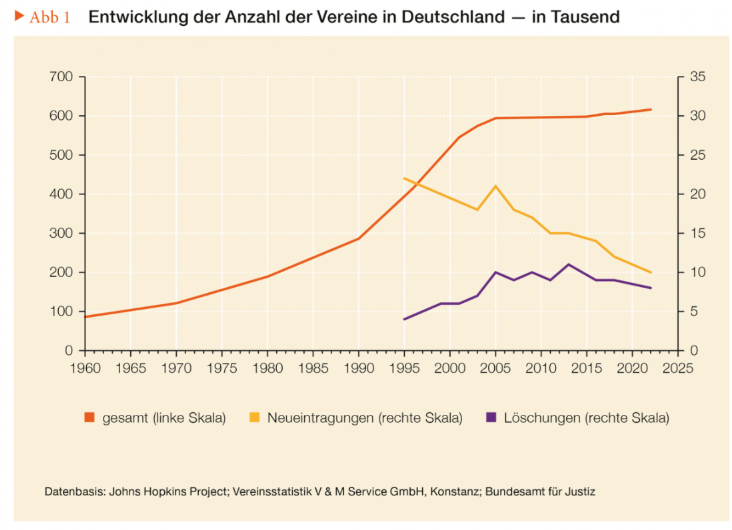
In Germany, associations are a central pillar of social life. According to the analysis of the ZiviZ-Survey 2023, around 656,888 civil society organisations were recorded in 2022 - of which registered associations accounted for around 94%. The largest growth in the number of associations between 2016 and 2022 was recorded in Berlin and Bavaria .1 Within 60 years, the association landscape has expanded enormously - from around 86,000 registered associations in 1960 (West Germany) to around 616,000 in 2022 (Germany as a whole) .2 However, the rate at which associations are being founded has been declining again since 1995.

Figures show: Civil society involvement in Germany is primarily focussed on sport, culture and education. This is followed by leisure activities and social services. Environmental protection and nature conservation also play a visible role, but are less often the main focus. Smaller fields such as international solidarity, science or media are much less represented .4
This shows impressively that association work is established, stable and broadly anchored. Associations offer spaces for commitment, community, learning, sport, culture, neighbourhood and much more. They are often locally anchored, characterised by voluntary work - and therefore particularly flexible.
The challenges
Most organisations work with very limited resources. More than half of civil society organisations in Germany have a total income of less than 10,000 euros. Only 27 per cent of organisations have paid staff .6
And: the understanding of the role of civil society organisations is changing. More and more organisations want to participate in political processes. Expectations of the state are also changing, particularly with regard to greater financial support. The background to this is the clearly recognisable tendency for organisations to increasingly act as gap fillers for missing state services. Organisations are getting involved in areas that were traditionally the responsibility of the state .7
Foundations - Promoting and supporting role
Alongside associations, foundations play a central role - both as project sponsors and as supporters of engagement. According to the Federal Association of German Foundations, the number of foundations with legal capacity under civil law in Germany totalled 25,777 in 2023 .8 This means that 637 new foundations were established in 2023.
However, the density of foundations varies greatly from region to region: by far the largest proportion - 88.4% - are based in the western German states (excluding Berlin). There are 1,903 foundations in the eastern German states, which corresponds to 7.4%. Berlin, with 1,081 foundations, has a share of 4.2%. However, it is interesting to look at the dynamics: in 2023, the eastern German states (excluding Berlin) recorded average net growth of 3.8%, which is significantly higher than the western German states (excluding Berlin) at 1.9% .9
In addition, the German foundations are dominated by a high number of small foundations: two thirds have less than one million euros in capital, only around 13% have more than ten million euros. This shows that many foundations work with rather modest resources - their contribution lies primarily in work, networks, strategy and long-term thinking .11
Significance for civil society
Why are these organisations so important?
-
They enable engagement: associations create structures in which people can organise themselves, start projects and make an impact. Without an association infrastructure, many initiatives would not exist or would only exist temporarily.
-
They pool resources: funding, expertise, space, networks - all of this is channelled through such organisations. Foundations promote, associations realise.
-
They lend visibility: social issues such as integration, sustainability, culture and youth work gain weight when they are represented by many organisations.
-
They stabilise commitment: When voluntary commitment is supported by institutional structures, long-lasting offers are created - not just individual actions.
- They enable participation: Local associations, citizens' initiatives and neighbourhood associations are the basis for democratic participation and involvement.
Outlook
The association and foundation landscape remains a central building block of civil society. In order to make them fit for the future, framework conditions such as sufficient funding, counselling, networking and professional support are needed. Anyone who wants to promote volunteering should therefore not only focus on individuals, but also on the organisations behind them - their diversity, their structures, their impact.
Sources
1: https://www.ziviz.de/sites/ziv/files/ziviz-survey_2023_main_report.pdf?utm_source=chatgpt.com S. 2
3: Fig 1: Development of the number of clubs in Germany in thousands (bpb) Licence: cc by-nc-nd/3.0/en/ (https://www.bpb.de/kurz-knapp/zahlen-und-fakten/sozialbericht-2024/553372/zivilgesellschaftliche-organisationen-als-infrastruktur-des-zivilengagements/)
4: https://www.ziviz.de/sites/ziv/files/ziviz-survey_2023_main_report.pdf?utm_source=chatgpt.com p. 17 (graphic)
5: https://www.ziviz.de/sites/ziv/files/ziviz-survey_2023_main_report.pdf?utm_source=chatgpt.com P. 17 (graphic)
6: https://www.ziviz.de/sites/ziv/files/ziviz-survey_2023_main_report.pdf?utm_source=chatgpt.com S. 2
7: https://www.ziviz.de/sites/ziv/files/ziviz-survey_2023_main_report.pdf?utm_source=chatgpt.com S. 2
10: https://www.bpb.de/kurz-knapp/zahlen-und-fakten/sozialbericht-2024/553372/zivilgesellschaftliche-organisationen-als-infrastruktur-des-zivilengagements/ (Graphic 2023, outdated)